In the updated "SOP" on what is allowed and prohibited during the next tightened Movement Control Order (MCO as the government calls it, or what we locals refer to as semi-lockdown), an interesting item is added in the prohibited list - outdoor photography. I am not here to question the judgement of the officials or challenge the authorities, but this new statement changes things, and I want to discuss it here. I am a photographer that earns a bulk of his income from shooting outdoor, and even my content creation was mostly done outside. 

The full list of updated SOP items, go to the bottom right you will see outdoor photography is now banned. 

Previously, the statement was "public filming not allowed", meaning cinematographers or filmmakers need to record their video in an indoor environment, like a studio. Nothing was mentioned on photography, but being cautious and not wanting to set a precedent to bad things happening to the photographers crowd, I have refrained from doing any street photography, or any outdoor photography at all since the beginning of this MCO 3.0 on 7 May 2021 (technically, 7 May was the start date for Kuala Lumpur residents, but the nationwide partial lockdown began on 12 May onward). I did however go out with my cameras of course, not actively hunting for photos, since I am a photographer, I carry my camera everywhere with me (if you don't, you call yourself a photographer?), and I will steal a few shots there and here when I see the opportunity. It was different back then, because there was no specific rule saying photography is not allowed. As long as I am not wielding the camera, walking around aimlessly, I should be fine, since chances of being caught is very low. I will take out the camera when I see something that caught my attention, take a quick shot, and the camera goes back into the bag after that instantly. I am playing very, very safe, but I cannot deny the photographer in me who wants to have some shutter action. The fingers do get itchy. 

Now the rules have changed so drastically. It is said outright - clear and bold - outdoor photography is prohibited. 

That means, you cannot go to the road side with your camera for that sunset shot over the urban skyline. You will be fined, possibly up to RM10,000 (USD2,500). Man, you can afford a brand new E-M1 Mark III with that kind of money, with some change. You cannot just bring out your super telephoto lens and catch some birds at your neighborhood trees. You want to go out your house just because you hear that rare bird calling? You might get sent to prison on the spot if you get caught. You want to walk around with the camera hanging around your neck just in case you spot some interesting moments on the street? Be prepared to be stopped and questioned by the police. Good luck in explaining your reasons. The police or the army should they choose to mobilize, are only doing their jobs and following orders. They see you with a camera, you are doomed. 

I have never been so afraid being a photographer. What have I done wrong to deserve this?

Before someone starts asking me to go to the police and seek special permission to "work" as a photographer, forget it. Now that it is a national law, by the National Security Council, you think the police will make an exception so easily? I'd get higher chance of being struck by the lightning in a thunderstorm. 

I fail to see how the camera comes into the equation, and how photographers are being banned. If you say, no social gathering, that is fine. Or no two people should walk together, or no crowd is allowed, that is perfectly understood. But people get together with or without a camera. Just because there is a camera does not mean there is a crowd. Photographers like myself shoot alone 99% of the time. I do my YouTube videos, filming myself alone. I am a one man crew. I have no one to infect, and there is no one to infect me. Just because I have a camera, and I do photography outside, what danger do I pose? How am I a threat? You see, we all play our parts and do the best we can in terms of social distancing and prevention, but now that the government themselves put a formal ban on photographers, I just feel so attacked somehow. Like I have done something wrong, being punished for no reason. 

Before anyone starts giving me ideas to shoot photography indoors, just don't. You are not helping. Keep your ideas to yourself and do it privately. In case you are not aware, I have been around for more than 10 years, sharing photography consistently and frequently, uploading fresh content without fail. I am not lacking ideas. That is NOT the problem. The problem is the government puts an official ban on me and restricts my right to use my camera. I don't see how that is fair, but who am I to say anything? I am just a nobody. 
Please support me & keep this site going:
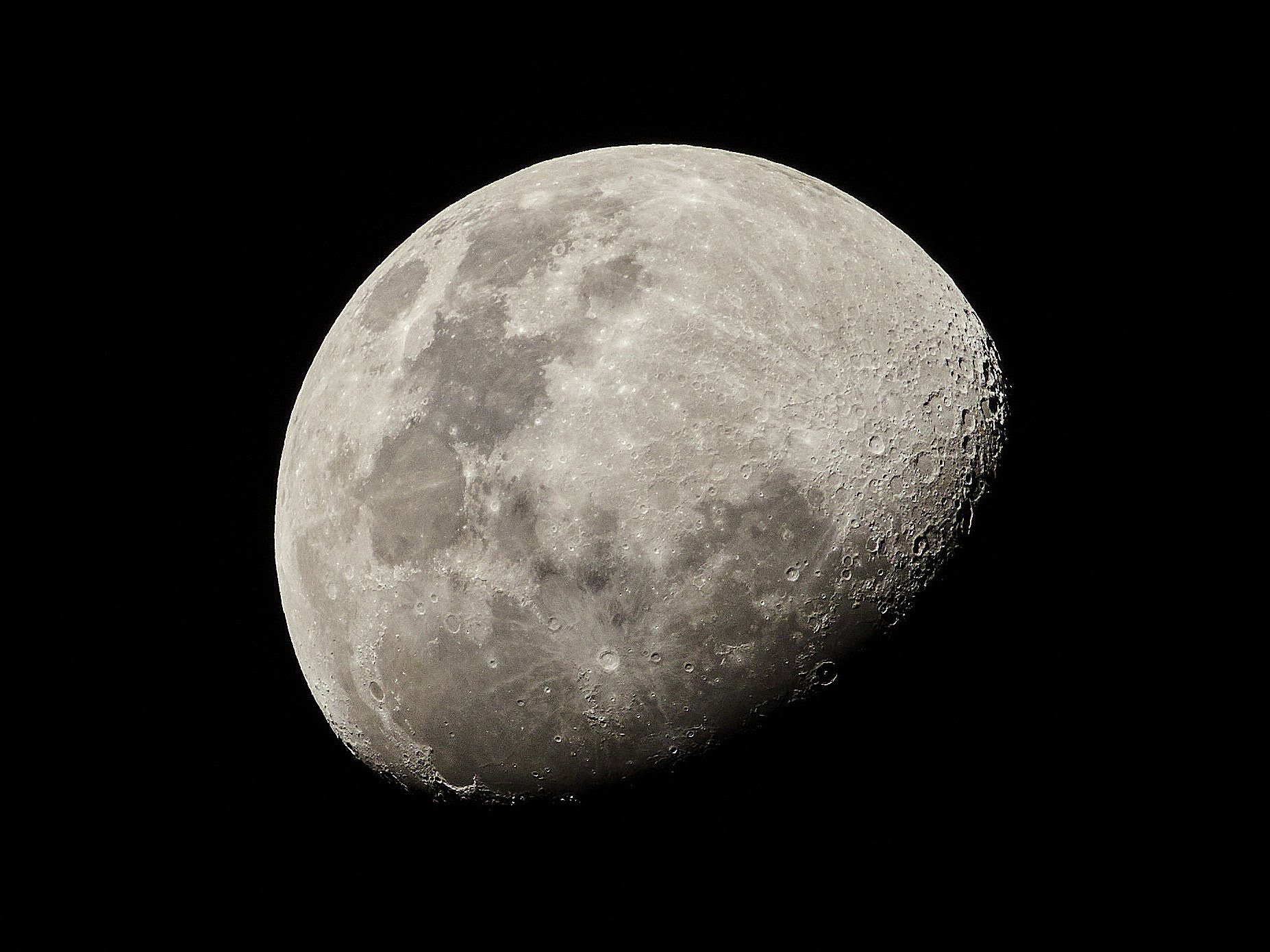
I saw the moon outside my room window and I just could not resist the urge to pick up the camera and make some shots. After all the Olympus M.Zuiko 100-400mm F5-6.3 lens which is on loan from OMD World Imaging is still with me. Just within a quick minute, I got the following shot. Everything done hand-held, no tripod, monopod or any extra support needed. The magic of image stabilization, and modern digital imaging technology, you can capture subjects from a far distance with ease, right from the comfort of your own bedroom, without much effort. 

1/200, ISO200, F6.3
E-M1 Mark III and M.Zuiko 100-400mm lens
Hand-held

The trick here is to use spot-metering. And you will get fast enough shutter speed to hand-hold the long lens, even the Olympus 100-400mm lens with the furthest end at 800mm equivalent (in 35mm format), at 1/200 second shutter speed, it was a breeze considering we do have powerful image stabilization to help steady the shot. The image show above is heavily cropped of course, I did not have any of the tele converters with me, but even the cropped image revealed plenty of good details and impressive contrast. 

Some people said that they don't see the Olympus 100-400mm resolving fine details, referring to my previous blog entry/YouTube video on bird photography at KL Bird Park. I was like... how many more fine details do your eyes need to see? Yes, the PRO lenses like 300mm PRO, or most possibly the newer 150-400mm PRO will give you better details resolving power, but to say that this lower level 100-400mm cannot resolve good enough fine details, and does not have good enough sharpness, is a laughable conclusion, considering I have shown so many examples proving just the opposite. It is sharp. It is not that easy to get such pin-sharp results, but you can get it, if you put in enough effort, and know what to do with the lens. A 800mm equivalent lens is definitely not for everyone. 

While the size may not be ultra portable, but this combo is perfectly hand-holdable, and handling wise, there is zero issues. 

I really can't wait for this current semi-lockdown situation in Malaysia to be over. From the looks of it, I doubt that can happen any time soon. The government has just announced stricter measures to be implemented in a few days, signaling the longer battle ahead, and lockdown that will not be eased any time soon. I have a strong feeling that if the number of daily active new cases does not drop drastically soon (currently hovering above 6000 new cases daily in Malaysia, inching closer to 7000 cases), it is no surprise a total lockdown as seen from last year's first March Movement Control Order (MCO) will be enforced. It is inevitable. I don't see how the current measures are sufficient to bring the numbers down. 

That also, unfortunately means, I won't be having much opportunity to shoot fresh images and make new contents. 

Wherever you are, I hope you fare better than me here. If you have a camera and you are free to go out to shoot, don't take that for granted. Go out and take more photographs. For me please. 

Please support me & keep this site going:
I'd highly encourage any photographer to print his work. It can be something you want to hang on the wall if you have the space in your place, or making small prints, like a photobook can be just as rewarding. Viewing photographs on print is an entirely different experience which I want to discuss in this blog entry, as well as how making prints can help you to improve your game in photography. I have also recently made a few photobooks for my own personal work, mostly a collection of recent street photographs, and I have showcased a full photobook (every page) in a recent video I have made, with this similar topic (click here for the video).  

My latest two photobooks, made this year. A collection of photographs shot on KL streets from January to April 2021. They also include some shots taken with the Olympus Air! 

In addition to the two books with new images, I made another photobook for my Bangkok trip in 2019. I figured out, why not, since we are now stuck at home and can't travel, so looking back at these photos while making the photobook was quite fun too. 

SCREEN VS PRINT
Most people view images on screen these days. The magic of print is slowly lost on the current generation of photographers, who crave instant gratification of getting likes and comments on their social media, posting immediately. Viewing experience on screen, any screen, either smartphone, laptop, or even large television screens will be different from viewing photographs on actual prints. What we see in real life, at least most objects do not emit light - humans, animals, plants, structures, they reflect light. Our eyes see reflected light to make out our vision. However, images shown on screens were 100% backlit by LCD or OLED, these images are made of millions of pixels, individually shining their own light. On the other hand, paper, or any printing medium does not emit their own light, but rely on other source of light to shine on the print to reflect light. The reflected light off prints will give you a more organic, realistic and more complete viewing experience when seeing photographs. They represent reality much, much better. 

NO PIXEL PEEPING
Also, when presented images on screen, many people are so quick to pixel peep. They will pinch to zoom and scrutinize the fine details, noise level, and identify areas with highlight clippings. The focus was placed wrongly on the technicality of the images, rather than really looking at the core of photography. When you show someone your photographs on prints, they have no choice but to look at the image at its entirety. You cannot pinch to zoom a print, and if the print quality is good enough (say 300dpi resolution or more) you can put your eyes as close as you can to the paper and you will not see any pixelation. When you see print, you see the core of the photographs - the idea or message that the photographer is trying to convey, the emotion that the image is invoking, the moment and drama that the shot has successfully captured - the storytelling aspect of photography which has been lost by instant gratification of online social media viewing. Hey I am not judging, I am also guilty of the same crime. Aren't we all, mostly?

MAKING A PHOTOBOOK
Making a photobook is so easy. I used Photobook Malaysia, and this is not sponsored by the way. I have no affiliation with them, though they probably know of my existence since Malaysia is not exactly a large place. Their service is simple to use, you can design a photobook using their app or website without buying anything, and when you are ready, the cost of each book, the ones I have printed (8"x11" landscape) is about RM40/USD10 including local shipping. It does not take too much of your time, and it is so so so fun to do! The feeling of receiving the photobook, and looking at your images on print is just priceless. 

The second book for this year. I used to print a photobook quarterly. But I guess the timing for the past more than a year has been screwed up due to multiple lockdowns. I just print whatever I can. 

My favourite street shot from Bangkok, Thailand in 2019. I wonder when we can travel again. 

Curation is important, how you arrange and sequence your photographs together so they flow from one to another and when seen in a series, they make sense and can tell a larger story. 

I will make a few more prints digging out from my older photographs. But I am more excited to make new photographs and print them. I am not sure when that will be possible again. 

CURATION
How can printing a photobook, or making any prints make you a better photographer? It is the curation process that counts. When you want to make a book, you need to select, organize, cut down, sequence and finally fit just the few curated images into the book. Yes you can fit 500 shots in a monster sized book, but that defeats the purpose. Doing mini projects, or having a series of photographs in mind will help you to tell a story more effectively - typically within the same topic or theme. Say you want to shoot a series of images with trees in your neighborhood, or specifically looking for yellow cars in various locations (hello Matti Sulanto). Once you have enough photographs, you then go through a tight curation process to narrow down your shots. You need to decide which babies to kill. This is the painful process. All photographs are babies and they are precious. We are emotionally connected to our own photographs because we made them with love, we spent time, resources and even the gear that we use to shoot those images are not cheap. They mean a lot to us, but you see here is the problem - that emotional attachment is not visible to your audience. The people viewing your photographs cannot understand why those photographs mean so much to you, so you need to be able to put these emotional connection aside, and look at your photographs objectively. Then kill your babies.

What separates a great photographer from the rest? His curation process. He knows how to hide his bad shots. He knows only to show the best of the best of his work. All photographers have bad shots. But not all photographers hide them well enough. Curation will help you understand that and more importantly, understand yourself better. Once you have printed those images, you will have another second look - you will clearly see how some images cannot fit into the series, or should not have been printed. This is a learning process, an on-going journey even for the most experienced photographers. It is not as simple as just selecting the few images that you like and print. You need to truly look at your body of work, reflect on yourself, understand yourself a little better, know where you stand, your progress of photography and this will ultimately help you decide your direction that you want to pursue next in photography. Print that photobook, and all this, will start to roll. 


If you are new to photography, I highly suggest that you consider making some prints! Photobook should not be expensive, and printing will make you a better photographer. My friend Wesley Wong (master printer in Malaysia) always said - it is not done until it is printed. 
Please support me & keep this site going:
Now that we Malaysians are forced to be stuck at home due to the government's forceful implementation of partial lockdown (Movement Control Order), I have had a lot of time to reflect and look at myself, I mean, seriously look at myself. The other day, after the failed attempt to shoot a self-portrait for Raya greeting, I went ahead and took some fun shots of myself in the process. And it got me thinking about my own small fitness journey and body image issues. 

When you are in the gym and you work out next to a 15 years old boy with bigger biceps, you start to question your entire existence. 
To all my Muslim friends and blog readers, Selamat Hari Raya Aidilfitri! Maaf Zahir & Batin. 

Image shot with Olympus OM-D E-M5 Mark III and M.Zuiko 25mm F1.2 PRO on a tripod. 

I have a funny story. 

I actually made a last minute shopping for Baju Melayu. Since it is now under lockdown I can't try it on as the fitting room is not accessible. I bought "XL" size, which should fit me, like most of my shirts that I wear. I then set up the lights, mount the camera on tripod, and got ready for a self-portrait of me wearing the Baju Melayu. I was in the festive mood! 

As I put on the shirt... with one quick slide, I heard and felt the hard, and undeniable Riiiiiiiiip. I shredded the shirt so badly, it was almost torn in two. 

So here I was, wearing a T-Shirt, wishing you Selamat Hari Raya. Do forgive me, I have tried. 

Please support me & keep this site going:
In case you have not heard, Malaysia is on another semi-lockdown, or what the government preferred to call it "Movement Control Order" (MCO for short). I am not going to dive much into details, but it is what it is, a miserable, no social activity, no meeting your friends kind of situation. Thankfully, I managed to catch up with quite a few people before this round of semi-lockdown happened. Special thanks to the amazing Jon Low, I was invited to his mini dinner party. He cooked some awesome food and we laughed too much over conversations that spanned past midnight. 

Of course I brought along my Olympus OM-D E-M5 Mark III, and my favourite lens M.Zuiko 25mm F1.2 PRO to capture some snapshots. Camera and food goes well together. 

One plate of heartful meal. I am impressed, Jon!

I loaned the Olympus M.Zuiko 100-400mm F5-6.3 IS lens from OMD World Imaging (sole distributor for Olympus products in Malaysia) to revisit the lens performance, this time in better lighting conditions. I have done a full review for Olympus 100-400mm lens before (click here) but the sample shots were taken in cloudy weather, and high ISO numbers. I thought that did not do justice to show off what the lens is truly capable of, so this time, I was determined to shoot with only low ISO and in ideal lighting to see just how sharp this Olympus 100-400mm can be! And boy oh boy, spoilers alert - the lens is incredibly sharp.

I have made a video for this same topic, so if you prefer to watch, go to my YouTube here (click). 

Lens and OM-D body combination is still perfectly hand-holdable, and handling was quite good. Lens feels balanced, I had no issue using this combination for about 3 hours shooting duration non-stop.